 Zainab Mahmood
My mother has this irksome habit of citing Hadith to get her children to do things. Her favourite, by far, has always been “Heaven lies beneath the feet of your mother,” followed tactfully by a demand for a foot massage: “Come claim your Paradise,” she loves to declare. My father never had such faith-based instruments to manipulate at the behest of sore feet. Then again, he wasn’t the one waking up at three in the morning to send us off to school every day.
There is a special reverence the Islamic faith accords to motherhood, evident in the Hadith I referenced earlier and the one that reverberates through Bassem Tariq’s and Mahershala Ali’s masterful excavation of religion in Your Mother Your Mother Your Mother, which ordains that your mother deserves your kindness threefold before a father is even mentioned. Such esteem is well-placed, disregarding my mother’s penchant for emotional blackmail.
I would put the personal anecdotes aside, but this proves especially difficult given how personally I felt the themes of Your Mother Your Mother Your Mother. While my dad, despite all his working-class might and grit, awkwardly struggled to keep the house in order when mom was sick, for Latif (Mahershala Ali), a Muslim hitman with a moral code steeped in many flavours of hypocrisy, losing his wife and mother to his children means, as his son so profoundly puts it, ‘filling shoes three times his size’; and he is met with a far more pressing and poignant ordeal when he is left with a hungry infant daughter.
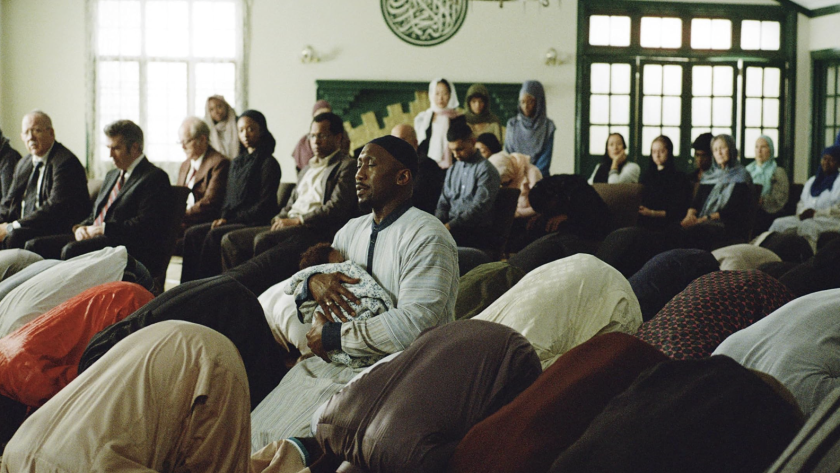
The tale of a single parent struggling to feed their newborn is one that is not foreign to Islam. Just as Hager ran seven times between two hills in search of water for her baby, Latif runs frantically from mosque to Pentecostal church to find breastmilk for his Zizi. Except this time, there is no miracle spring of Zamzam in sight, only religious cults, underworld crime bosses, pornstars, and internet furry freakishness. Admist this onslaught of all sorts of haraam, Mahershala Ali brilliantly portrays a Latif out of his depth in a pool of blood and spilled milk that threatens to consume him as he navigates debilitating faith incited by grief and morality in times of desperation.
Femininity courses through the veins of what could have simply been another classic action-thriller with a muscular leading man out for vengeance. But this ain’t your sheikh’s John Wick. It’s a story about the delicate struggle of a father unable to feed his newborn; in this particular case, hunting down a man would be a far simpler endeavour. Latif’s wife, Khadija (Shakirah DeMesier), haunts the narrative in a manner distinct from the ‘dead wife’ trope to which action films may often succumb. She is no deceased MacGuffin, murdered to drive Latif and the plot to stab their way through some big bad. Her death is an ordinary tragedy whose consequences manifest not in bloodlust or anger, but in an undeniable void and domestic disorder. Big shoes indeed, and ones Latif must learn to fill. It is through this reluctant assumption of maternal responsibility that his character arc establishes itself. Latif finds recourse in developing traditionally feminine sensibilities, in lieu of the masculine instincts and adrenaline that have served him so well elsewhere, learning to listen before he lunges and to consider his family in ways that often elude men oblivious to the invisible labour of the women around them. And thus, where he begins the film miles away from home, bashing someone’s brains in a public toilet while his daughter desperately rings him, he ends it lying quietly back home in a tender embrace with his three children.
For a Hollywood story centred on interrogating the practice and perception of religion, the film is exceptional in its nuanced celebration of faith, particularly amidst heavily propagandised xenophobia and Islamophobia in the West, while remaining unafraid to ask sincere questions about the fatality of creed under heavy distress. How do you calibrate faith for comfort when you can’t pray your loved one back to life? What does it even mean to fast when your grief has already expunged you of all appetite? Which sins are absolved in the wake of crisis and which ones demand extensive repentance? Bassem Tariq’s exploration of these dilemmas runs with a rare undercurrent of mercy. My eyes could not help but linger on the first words with which the film opens — “In the name of God, the All Merciful, the Giver of Mercy,” a phrase that mostly dissolves out of frame, with the only fragment that persists being “the Giver of Mercy.” The film honours that divine characteristic in the grace it affords its characters; yes, even the religious cults, underworld crime bosses, pornstars, and, no matter how seemingly unlikely, internet Furry freakishness.
Latif is not struck down for his hesitance to prostrate in his fragile state of mourning: “You take her from me,” he utters in a bitter voiceover, “and you expect me to bow down to you?” His eldest daughter, Fatiha (played with abyssal emotional depth by breakout star Adia), is not cursed out for cheekily sneaking Cheetos on her fast or viewing questionable online content using stolen Wi-Fi from the Mormon boy who, by the tenets of his own faith, shouldn’t have it in the first place. Forgiveness is even extended to teetering Muslim and internet pimp Hatty, around whom the primary conflict escalates.
What is on display is a fascinating interplay of poetic and naturalistic contradictions. We find characters attempting to reconcile their faith with their desires, needs, and lived experiences as individuals. Islam certainly doesn’t condone self-appointed assassination agendas, but Latif believes his are justified in protecting his community from those who threaten it, conveniently sweeping the matter of payment under the prayer mat. His blade is accompanied by a pack of baby wipes, serving the dual purpose of cleaning your baby’s bum and scrubbing your enemy’s blood off the sink — an essential for any new parent with a kill bill. Hatty, whose darkly comedic sleaziness is played to perfection by Abu Bakr Ali, contemplates reverting to Islam despite his staunch commitment to curating “Habibi Porn”. He, both verbally and innately, demonstrates the hypocrisies of those who can indulge in vice and preach piety in the same breath. These contradictions are supplemented by John Cho’s menacing portrayal of gun-wielding Christian leader and primary antagonist Hwan Yoon, whose crusade to purge the town of supposedly iniquitous criminals like Hatty holds up an uncomfortable mirror to Latif’s own self-righteous brand of vigilantism.
The film illuminates these contradictions and doles out justice without judgement, allowing its characters room to breathe through their struggles, come to terms with their shortcomings, be afforded the privilege of a learning curve, and ostensibly falter in their steadfastness to faith, as it is so often easy for humans to do. Tariq confronts those who weaponise religion to justify morally contemptible deeds, as in the cases of Latif’s convenient rationalisations and Hwan’s militant sanctimony, all the while not being blind to the flimsiness of religious devotion in the face of personal desire, and to why one might feel compelled to manufacture faith-based justifications for actions that would not otherwise be condoned. In doing so, he encourages onlookers of both religious and secular moral persuasions to extend compassion to those on the screen, to those around us, and to ourselves, reminding us that each and every one of us is fallible, fragile, and nonetheless deserving of redemption.
On a more technical, brief and less preachy note: it’s no surprise, given Mahershala Ali and Bassem Tariq’s likely experience developing Blade, which Marvel so gracelessly fumbled, that the action sequences are choreographed with articulate precision, the score provides an evocative and transcendental listening experience reminiscent of Islamic nasheed, and the cinematography and carefully curated mise-en-scène visually sculpt the symbolism essential to the film’s central theses. All the while, the entire cast delivers stellar performances across the board, with some incredible supporting performances from Giancarlo Esposito and Tramell Tillman.
In the past, there have been few depictions of the Islamic faith in Hollywood that I have not experienced with contempt (some might be familiar with my particular disdain for Kumail Nanjiani), so I could not help but temper my expectations for Your Mother Your Mother Your Mother. But in the end, I found that wholly unnecessary. I left my cinema puffy-eyed and eager to call my mom and thank her in her big shoes with heaven underneath them; I then proceeded to thank God for releasing Mahershala Ali from his Marvel prison to bless us with a film steadily climbing through the ranks towards becoming my favourite of the year.