
 Ernest Hui
 SPOILERS FOR BOTH HAWKS’ AND MANN’S FILMS
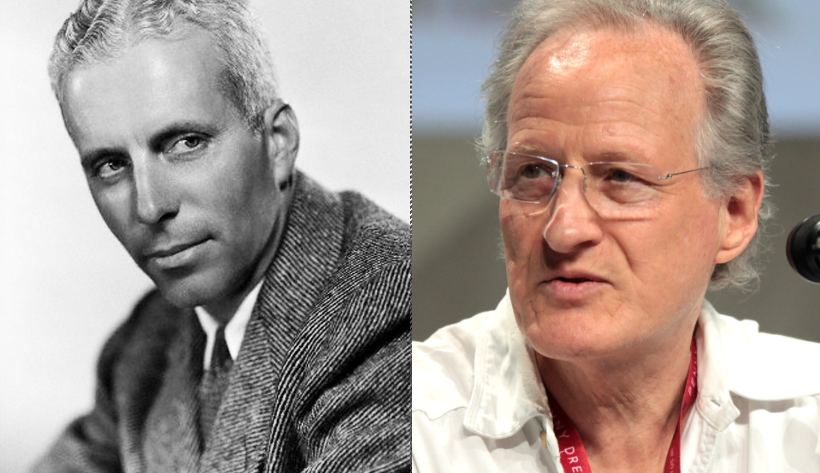
When we think about films that involve a collective of professionals, they often dominate the list of the greatest films ever made: think Akira Kurosawa’s Seven Samurai (1954) or John Carpenter’s The Thing (1982). Most, I would argue, are influenced by Classical Hollywood director Howard Hawks. (Funnily enough, in reference to my second example, Carpenter remade the original The Thing – a film not directed by Hawks but heavily intervened in by the man himself.) Hawks is not exactly as celebrated as his contemporaries – Alfred Hitchcock, Nicholas Ray, Billy Wilder – because he does not necessarily have a distinctive style that is easily recognisable, contrary to the aforementioned auteurs. However, it is in this aspect that Hawks excels. His non-distinctive formal style allows him a wide repertoire of genres: screwball comedies (some of his most famous works like Bringing Up Baby, Ball of Fire), musicals (Gentlemen Prefer Blondes. Side note: happy 100th birthday to Marilyn Monroe!), adventures (Only Angels Have Wings, The Big Sky), westerns (Red River, Rio Bravo), and even noirs (the notoriously convoluted The Big Sleep). Even then, it seems insulting not to call Hawks an auteur, because the common themes that often arise from these masterpieces are professionalism, romanticism, and relationship informed by the tension between both – which in turn saw Hawks merging into a pragmatic idealist, a suitable middle ground. What further distinguishes Hawks from other Old Hollywood directors is his recognition of the insanity of social norms (the closest director who has reached this level is Wilder) and the performances or bravado that individuals put up to impress others within the organically constructed groups he usually places his characters in. He thus subverts traditional character expectations: rationality and order keep individuals trapped in a system that denies them potential. Only extraordinary acts and chaos can free them.
This tension between professional codes and human (often romantic) connection is what makes Hawks’ work so enduring. But it also points towards another filmmaker who would take up Hawks’ thematic concerns and translate them into a very different world: Michael Mann. On the surface, Mann’s world of neon-lit cityscapes, digital surveillance, and cat-and-mouse crime thrillers could hardly be more distant from Hawks’ screwball comedies, vibey westerns, and so on. Yet Mann is arguably Hawks’ most direct cinematic heir – not in visual style, but in his same obsessive exploration of professionals navigating the impossible gap between their work and their humanity.
Hawks explored this theme across every genre he touched, but his screwball comedies offer the most direct challenge to the world’s imposed order. This is most apparent in Bringing Up Baby (1938). The film’s profound thesis is that the supposedly ‘normal’ world of academic order, tailored suits, and practical marriage is the real madness. Cary Grant’s David Huxley has spent four years assembling a brontosaurus skeleton with his fiancée – a controlling, practical woman who views their marriage as an extension of their academic ambitions – a monument to order and control. Then comes Katharine Hepburn’s Susan Vance, who does not disrupt his life so much as liberate it. She is free-spirited and craves David’s attention, doing almost anything from tearing his jacket to getting him arrested to keep him from his impending marriage. By the end, David is sitting in the rubble of his collapsed dinosaur, having accepted Susan and her chaotic nature. Hawks’ subversion sees the individual who clings to order as trapped. A man who refuses to go a little crazy will never reach his full potential.
But Hawks does not only celebrate this liberation through screwball comedies; he also reveres the quiet dignity of professionals holding a line together, suggesting that the same tension between order and chaos can manifest in a more stoic tone. This is most evident in Rio Bravo (1959): a sheriff, a drunk, a cripple, a youngster, a woman, and a hotel owner defending a small town against outlaws. No one admits they need each other; everyone performs self-sufficiency. John Wayne’s John T. Chance would rather walk into a gunfight alone than ask for help. But the film’s quiet strength is that help arrives anyway: Dean Martin’s drunkard Dude sobering up at the right moment, Angie Dickinson’s Feathers stepping in without being asked. True competence is knowing when you cannot do it alone, and the grace to let others step in without being asked. Hawks understand competence as a shared reality that everyone agrees to maintain. Everyone stays cool while quietly carrying their own vulnerability. Earned trust is sacred in Hawks’ world.
Hawks’ vision of professionalism also cut across gender lines, further complicating any simple reading of his work as merely masculine codes. Despite his conservative upbringing, he was refreshingly progressive for his time. One of the most prominent examples is his treatment of Rosalind Russell’s Hildy Johnson in His Girl Friday (1940). Hildy was written as a man in the original 1928 play The Front Page, but Hawks changed the character to a woman to highlight a sense of ‘double burden’ for women – having to work for her own professional career while taking care of domestic duties (which Johnson is inclined to do near the start of the film), and the tension that came with it. From this, many film scholars coined the term ‘Hawksian woman’ to describe a strong-willed, independent woman that is exempt from the usual Hollywood trap of reducing female characters to mere romantic interests. Hawks, in that sense, was one of the pivotal directors to allow this change in perspective in how we viewed society as a whole. So where does Michael Mann fit into all of this? He only began directing features after Hawks’ death in 1977, and as mentioned, his world could hardly be more different. But watch closely, and you will see that Hawks and Mann go hand in hand.
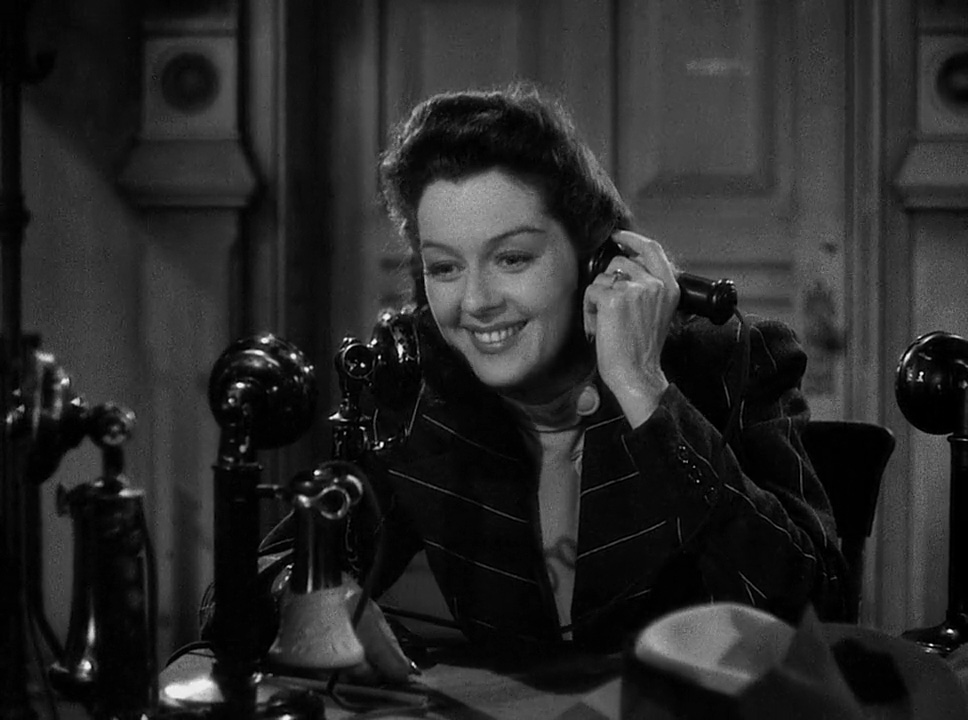
Rosalind Russell in His Girl Friday, dir. Howard Hawks
Despite Mann’s range being more limited (not to his detriment, of course) – largely confined to crime thrillers (Manhunter, Heat, Collateral, Miami Vice) and the occasional historical biopics (Ali, Public Enemies) – he more or less operates in the same way as Hawks. The professionals in both directors’ worlds assume absolute competence while they struggle to adapt within a ‘normal’ society that demands dogmatic adherence to social codes. Where Hawks explores the tension between the nonchalance presented in the collective and the vulnerability of the individual, Mann explores the dialectic between traditional codes of morality and a post-capitalist, globalised modernity – with these professionals attempting to find any meaningful human connection.
Consider Thief (1981), his first acclaimed feature. James Caan’s Frank is a safecracker who wants nothing more than to finish one last job, marry someone, adopt a kid, and live a normal life. He is a professional who dreams of becoming an ordinary man. But the system (cops, mobs) will not let him out of the game. By the end, Frank torches everything around him (literally and metaphorically) just to survive and walk away clean – but he walks away alone. In Mann’s world, mastery of the job and mastery of the self are opposing forces repelling each other.
The same dynamic recurs across his work, each time with a different flavour. In Manhunter (1986), William Petersen’s FBI agent Will Graham is so adept at getting inside serial killers’ minds that he risks losing his own. His professionalism saves lives, but the film suggests that this peace is only temporary. Will initially refuses to get deeper into the case – he’ll just review the files – but he cannot help himself. “Can you quit?” his wife asks. The answer is a resounding ‘no’. The FBI will ask for help again, and he will answer the call again. In what has been considered his magnum opus Heat (1995), Robert De Niro’s professional robber Neil McCauley lives by a rule: “Don’t let yourself get attached to anything you are not willing to walk out on in 30 seconds flat if you feel the heat around the corner.” Al Pacino’s detective Vincent Hanna has the same rule; both men lose their romantic relationships because of it. Mann’s point across these films is consistent: you can either be great at what you do, or you can be happy.
What ties all these films together is not just theme but texture, and it is in this texture that Mann’s vision of professionalism becomes most visceral. His visual language (using mostly digital film nowadays) moves between complete isolation and moments of warmth within a single shot. The suffocating geometry of city skylines gives way to a dreamy coastline. The ability to link the two creates a constant eroticism from such distance. Nowhere is this more apparent than in Miami Vice (2006). Watch the way Mann films Colin Farrell’s Sonny Crockett and Gong Li’s Isabella: their gazes fade as quickly as they are established; they share a genuine attraction, but Mann always keeps something between them: the symbolic separation of a window or the more literal and looming knowledge that she is a drug trafficker and he is an undercover cop. The eroticism comes not from what they do but from the distance they cannot close. These intimate moments radiate warmth and sensuality, yet an underlying existential dread permeates them. Perhaps they function as a final embrace before a personal ‘apocalypse’, where nothing else matters but the lovers themselves. These connections are built on borrowed time. Mann understands that in the world his professionals inhabit, love is a luxury the job cannot afford. However genuine the feeling, the circumstances are fatal to it. The best either party can manage is a graceful surrender: an unspoken acknowledgement that their lives are incompatible, and that separation is the only solution. And perhaps that quiet resignation is professionalism itself – the discipline of knowing when to let go. As Isabella says, “time is luck”, and it always runs out. Mann is not a pessimist, but a realist.
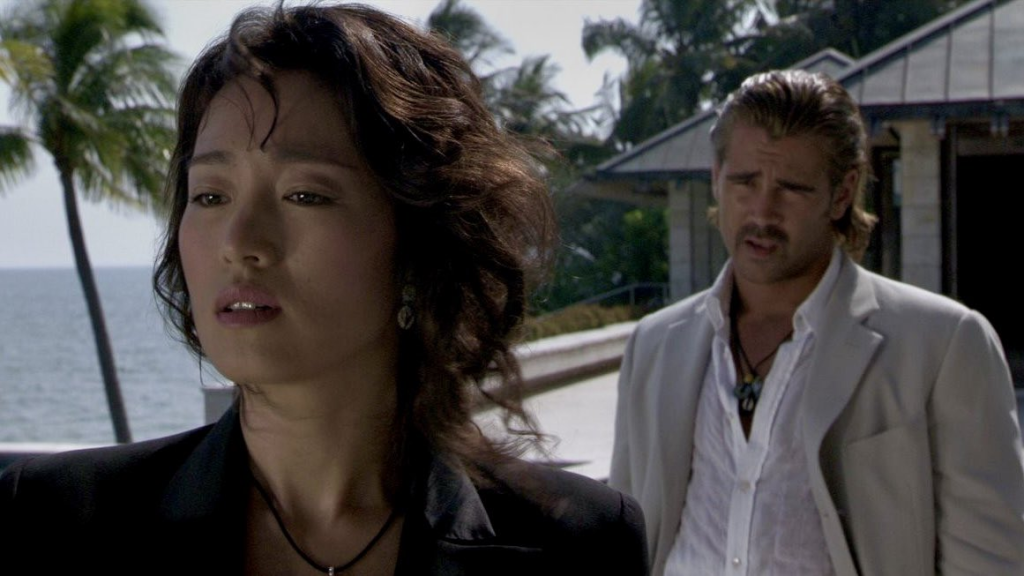
Gong Li and Colin Farrell in Miami Vice, dir. Michael Mann
This preoccupation with time, the sense that professionals are always racing against a clock that will eventually run out, forms the backbone of both directors’ work. Job after job, with no chance at connection. With Hawks, you can feel it in the way Only Angels Have Wings (1939) cycles through pilots dying and being replaced, the mail route continuing like nothing happened. You feel it in Rio Bravo, where John and his team pass the hours taking care of each other and singing My Rifle, My Pony and Me because the alternative – thinking about tomorrow, about the danger of facing bad guys – is unbearable.
A telling example in Hawks’ body of work is when he paired the now-iconic onscreen (and real life) couple Humphrey Bogart and Lauren Bacall for To Have and Have Not (1944). Bogart’s Harry “Steve” Morgan is a cynical, hard-bitten fishing boat captain who just wants to get paid and stay neutral (mirroring USA’s indifference in WW2 before Pearl Harbour and, cinematically, his most famous role in Casablanca as Rick Blaine), while Bacall’s Marie “Slim” Browning is a young drifter who sees right through his mask. On the surface, it is a wartime adventure thriller, but Hawks plays into the romance from the established setting. Harry insists he does not get involved, does not stick his neck out, and pretends to be indifferent towards romance. And then he does all three anyways, almost against his own will – a contradiction that suggests Hawks views professional detachment not as a genuine moral code but as a defence mechanism, one that his characters must eventually abandon to achieve genuine connection. Marie does not soften him so much as she recognises that his professional appearance is itself a performance, a shield he wears because caring gets you killed in a German-occupied French territory. The famous “You know how to whistle, don’t you, Steve?” quote is not just flirting, but also Marie calling Harry’s bluff – the line literally starts with “You know you don’t have to act with me, Steve”. She is telling him that competence without connection is just another empty routine without life. Hawks lets Harry have both the job (overturning his neutrality) and the girl, but only because he first admits that his professional stoicism was never as solid as he pretended. This is the Hawksian compromise in action: Harry does not abandon his professional identity; he simply acknowledges that it was always a performance, and that admitting vulnerability does not make him less competent, but more human.
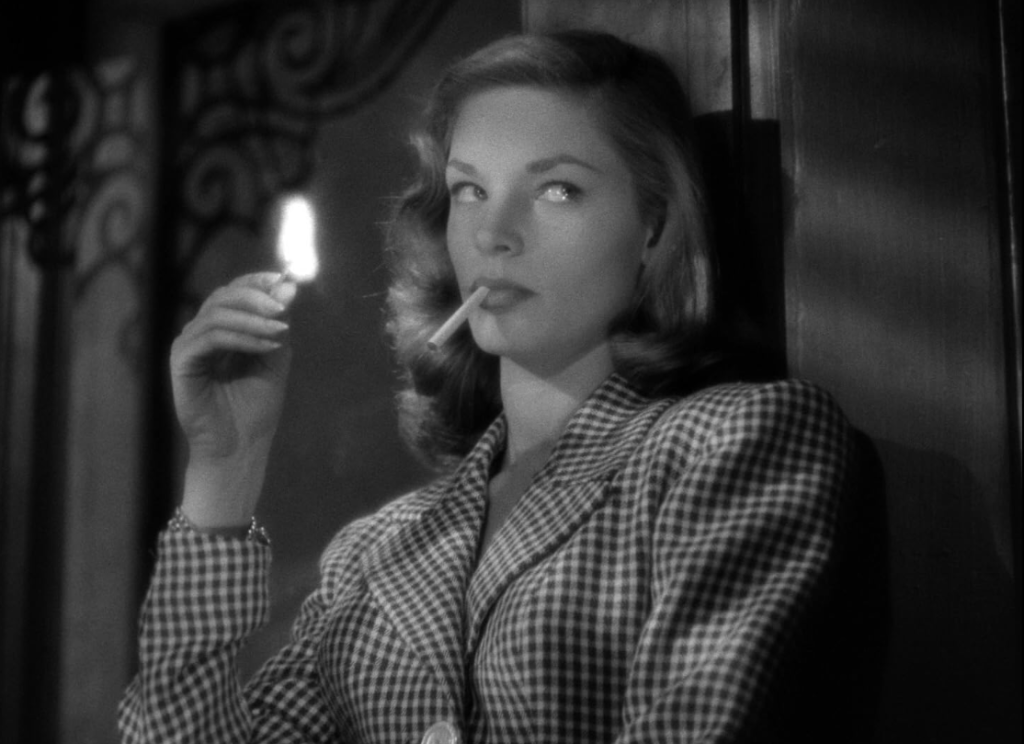
Lauren Bacall in To Have and Have Not, dir. Howard Hawks
With Mann, the same weight of time presses down. Neil’s 30-second rule in Heat is a direct admission that attachment is a liability. You feel it in Public Enemies (2009), where Johnny Depp’s John Dillinger knows he is living on borrowed time: the FBI’s new technological tools (wiretaps, ballistics) are starkly contrasted with Dillinger’s old-school professionalism (codes of honour, theatrical yet efficient bank robberies), which sees him lagging behind a world that is moving towards modernity (explaining Mann’s decision to shoot it on digital film). He knows the end is coming, and he is squeezed into corners by the cops.
Take Collateral (2004) as a deeper look. Jamie Foxx’s Max has spent 12 years driving a cab, polishing a fantasy of starting his own limousine company – 12 years of telling himself that someday he will make the call, that he will take the risk. Then Tom Cruise’s cold-blooded hitman Vincent steps into his cab and, over one night, forces Max to confront the truth. “Someday? Someday my dream will come? One night you will wake up and discover it never happened […] what the fuck are you still doing driving a cab?” It is cruel (and perhaps even hypocritical, considering Vincent’s own line of work), but it is also honest. Because of this immediate situation he is put in, Max is forced into genuine competence. By the end, he does survive and even performs a small gesture of grace by putting his coat around Jada Pinkett Smith’s Annie at the film’s climactic end. But you wonder what happens after that ending: Mann does not give us certainty. Yes, Max has proved himself professionally and has made a (somewhat genuine) human connection, however fleeting. But time still goes on, as the job does not end for him to chase this seemingly unreachable limo career. The professionals in these films do not lack skill or courage. What they lack is the one thing that professionalism cannot afford: time to stop, to breathe, to connect.
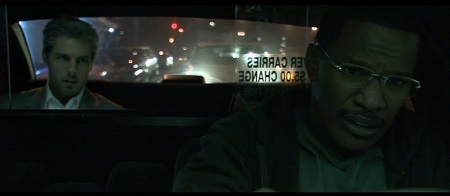
Tom Cruise and Jamie Foxx in Collateral, dir. Michael Mann
While I have spent this whole article trying to draw links and similarities between the two, there are obvious differences between the directors given the different periods of cinema they were situated in. These differences are not merely aesthetic; they reflect fundamentally different worldviews about what is possible for human beings within the systems they inhabit.
The first difference is how each director handles the possibility of resolution. Hawks, for all his cynicism about social norms, is ultimately an optimist. His professionals usually win or reach a compromise that ensures some sort of satisfaction for both the characters and the audience. The aforementioned To Have and Have Not is the obvious example where the couple ends up together. Hawks’ lesser known Barbary Coast (1935) offers a different variation: Miriam Hopkins’ Mary goes off with Joel McCrea’s Jim, abandoning Edward G. Robinson’s gangster Luis to the modes of justice. Luis recognises that keeping Mary in a loveless relationship with him would be impractical for both parties – a rare moment of pragmatic grace from the main antagonist. Even in Only Angels Have Wings, where the mood is more melancholic and uncertain of what would happen beyond the ending, Cary Grant’s Geoff Carter allows himself to love Jean Arthur’s Bonnie Lee, despite running towards the thing he loves most and is afraid to abandon – aviation – with uncertainty ahead whether he will survive the flight. Hawks’ pragmatism includes a small allowance for happiness, provided you have earned it through competence.

Only Angels Have Wings, dir. Howard Hawks
Mann, on the other hand, grants no such allowance. His endings are rarely happy; bittersweet at best. They are resigned. Frank in Thief walks away alone, having destroyed his possessions and relationships. Neil in Heat dies after breaking his code and abandoning Eady (albeit with Vincent holding his hand in one of the most emotionally charged scenes in cinema). Mann’s characters are trapped in a reality situated within the historical and social contexts that represent the institution as the omnipresent authority dictating these characters, leading them to their downfall. Hawks believes in the possibility of a middle ground, while Mann believes it is a lie we tell ourselves to reach for something unattainable.
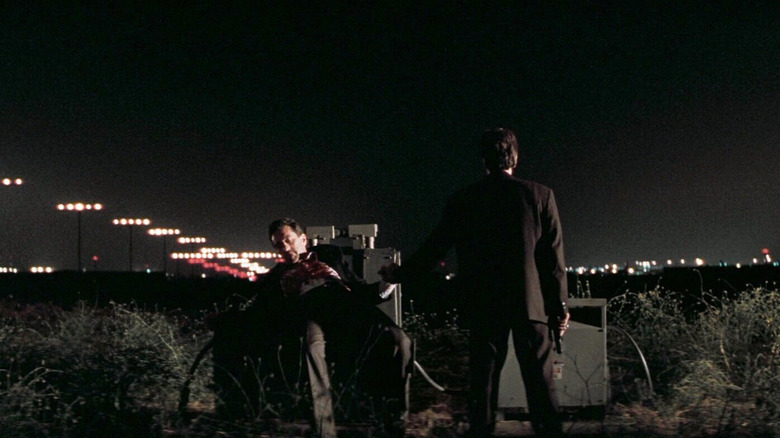
Heat, dir. Michael Mann
Another key difference – and perhaps the most revealing – is that Mann takes Hawks’ grammar and translates it into a world way after Hawks’ time, something he could not have imagined. Hawks’ professionals operate in self-contained, socially hermetic worlds: a South American airfield (Only Angels Have Wings), a frontier town (Rio Bravo), a newsroom (His Girl Friday). Their enemies are weather, geography, local gangs, etc. Mann’s professionals, by contrast, are swept up in forces far larger than any individual code of honour. They navigate transnational cartels (Miami Vice), global financial networks (Blackhat), post-9/11 surveillance states (Collateral), and the invisible infrastructures of a fully globalised capitalism. In Blackhat (2015), Chris Hemsworth’s Nicholas Hathaway travels across Los Angeles, Hong Kong, Jakarta to track a ghost-like hacker operating simultaneously across continents. The film’s geography is dizzying and deliberate – Mann shoots digital infrastructure as if it were landscape, as vast and tactile as the frontier town in Rio Bravo. Nicholas’s partnership with the Chinese and Americans, and his romance with Tang Wei’s Lien, are mediated and surveilled by governments, intelligence agencies, and even the antagonists that could fracture their relationship at any moment. Their bond is genuine, but the globalised world Nicholas inhabits does not allow for stillness. Mann preserves Hawks’ central tension of professionalism against romanticism, but he dials up the stakes from the personal to the geopolitical. For Hawks, you lose connections if you mess up your job. With Mann, you lose connections because the entire modern world and institution is structured to prevent people from staying in one place long enough for any real contact.
Maybe that is why I find myself returning to both of them. Hawks gives me the comfort of believing that the code has loopholes – that a man can be competent and still vulnerable, professional and still loved. Mann gives me the harder truth that these loopholes might not be compatible, yet he never dismisses anyone who keeps looking for them anyway. Hawks is a pragmatic romantic, while Mann is a romantic pragmatist. They are not the same, yet their work informs each other. A balance is needed when you watch films – I search for hope and mirrored reality in the same realm, and I believe Howard Hawks and Michael Mann are the two perfect solutions.
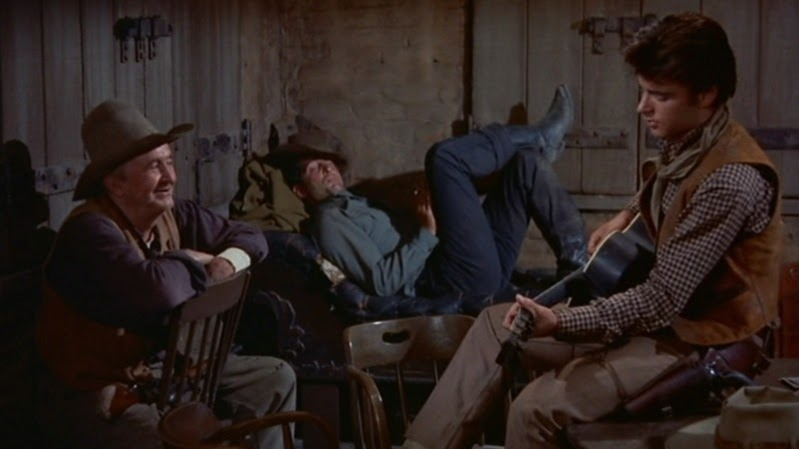
Walter Brennan, Dean Martin, and Ricky Nelson in Rio Bravo, dir. Howard Hawks
They are, without question, two of the greatest directors we have ever had. Not only because of their common theme of professionalism, romanticism, camaraderie, fate, time, and so much more are universally applicable to human nature, but because of how they construct their dialectic to come to an acceptable truth. Cinema, after all, is a form of truth-making, and I believe Hawks and Mann have guided us to that and allowed us to shape our values accordingly.