 Charlotte Peach
 Emerald Fennell’s “Wuthering Heights” is confronting. For instance, audiences are made to listen to moaning — of pain or pleasure, it is indistinguishable — for about 30 seconds before the film’s opening scene actually begins. And this precise tone of discomfort is the basis of Fennell’s entire film: sexuality isn’t as much hinted at for audiences, but enforced on them.
Across all of Fennell’s films, the erotic is a cornerstone, so it shouldn’t have been surprising that her rendition of Emily Brontë’s Wuthering Heights took ‘a sexually violent turn’, as Tina Fey says. Nonetheless, the sheer amount of innuendos and sex still managed to leave me shocked and uncomfortably laughing in the theatre. And the thing is, it’s not even really perverse or interesting; there’s just an awful lot of it. There are a lot of gooey, sticky things, but none of it is actually meaningful or provoking, so it just ends up being tiring, unsexy, laughable, and eventually numbing. At this present moment, it is hard to not draw comparisons between Fennell’s depiction of sex and the other prominent period entertainment piece of February: Bridgerton. However, where Bridgerton builds relationships gradually to have erotic scenes steeped with meaning, “Wuthering Heights” throws erotica at the screen, crossing its fingers that audiences will find an inkling of passion between the half-drawn characters. For instance, when Cathy and Heathcliff begin their clandestine affair, there is a sex montage set to a brilliantly autotuned Charlie xcx song. The result, however, is a glorified music video that misses almost all the romantic beats in a relationship, with little regard for chemistry or conversation.
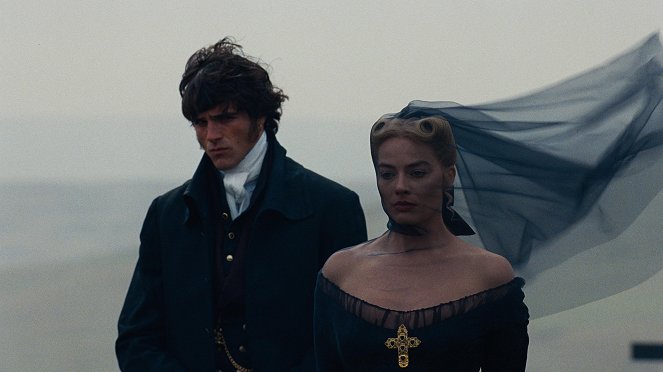
Similarly, Fennell’s film aesthetics are frantic and too maximalist for the story she tries to tell. Though at times this penchant for ‘sticky visuals’ can be lovely to look at (the title card was stunning), it’s overall exhausting and the film begins to feel less like a tragic story of repression and loss, and more like an artistically-scened music video for Charli xcx’s album. Or simply a pinterest board lathered across the Yorkshire moors. Fennell’s Baz Luhrmann-esque style lends beautifully to photography and the movie trailer is enchanting, but it draws audiences away from any actual emotional weight in the film. A tragic moment occurs? Don’t worry, the dazzling costumes and beautiful gardens of the next scene are here to instantly soothe you and draw your attention elsewhere!
Another significant issue of the film was the casting – a much discussed topic, and deservedly so. The film stars Margot Robbie and Jacob Elordi, both white actors from Australia, aged 35 and 28, respectively. Heathcliff, Elordi’s character, is written to be ethnically ambiguous and ‘dark’ in the novel, which is part of the reason why he is alienated from society and kept apart from Cathy: not just because he is adopted and behaves differently, but because he looks different. Wuthering Heights is not simply a story of love, but of class resentment, racial prejudice and how these forces destroy relationships and human beings, and yet Fennell decides to leave these forces behind… instead favouring the interpretation created by her 14-year-old self. An interesting idea, except for the fact that she is no longer 14 but an adult, with a fully developed brain and broader perspective, living in a world where these issues persist. Considering that 17 of the past 18 Wuthering Heights adaptations had a white actor depict Heathcliff, could Fennell not have simply cast a person of colour?
Similarly, Robbie’s casting was miles off, and it strangely felt like she was acting in a completely different film to Elordi. To preface this, I admire Margot Robbie greatly: her performance in Barbie and I, Tonya were brilliant, and importantly, she is a phenomenal executive producer (“Wuthering Heights” had exceptional marketing, and it will be one of the highest grossing films of 2026). However, her acting as young, bratty Cathy was boring and disappointing. It was entirely unbelievable that the 35-year-old Australian goddess was the wide-eyed, petulant Cathy. Maybe it was her unfitting accent, maybe it was simply the mature grace with which Robbie carries herself, but it all made for a simply boring watch, constantly destroying your belief in Fennell’s fantastical world.
There were actually some great performances in the film, but they just weren’t by the two leads, who felt like they were in different films altogether (Robbie in a Mills and Boon adaptation, and Elordi giving his best attempt at a vengeful Mr. Darcy, though that can probably be attributed to the lacking script). Alison Oliver (Isabella Linton), Martin Clunes (Earnshaw), Hong Chau (Nelly) and Charlotte Mellington (young Cathy) all gave quite brilliant performances, and I would have preferred more of the childhood scenes with the talented young actors.
My last note on the film is that I didn’t mind that it strayed from the original text, but I think Fennell should have gone all the way and created entirely her own period piece. I actually think it is very interesting and exciting that Fennell decided to put her own iteration of the classic novel – after all, that is what makes literature so exciting: that there are constant reinterpretations of single texts (albeit, problematic interpretations, as Fennell illustrates). But, in calling it “Wuthering Heights” (quotations or not), she gave many people hope of a faithful, high budget, exact adaptation of a beloved gothic masterpiece, giving the vengeful (Healthcliff-like?) English students have valid grounds to tear it to pieces. Moreover, I think Fennell is at her best when she is creating original material, and therefore, were she to create her own period piece, loosely based on Wuthering Heights (similar to how Saltburn is loosely based on Brideshead Revisited), I think she could have struck gold. But alas, we are left with an incohesive, baffling, and sadly boring film.