
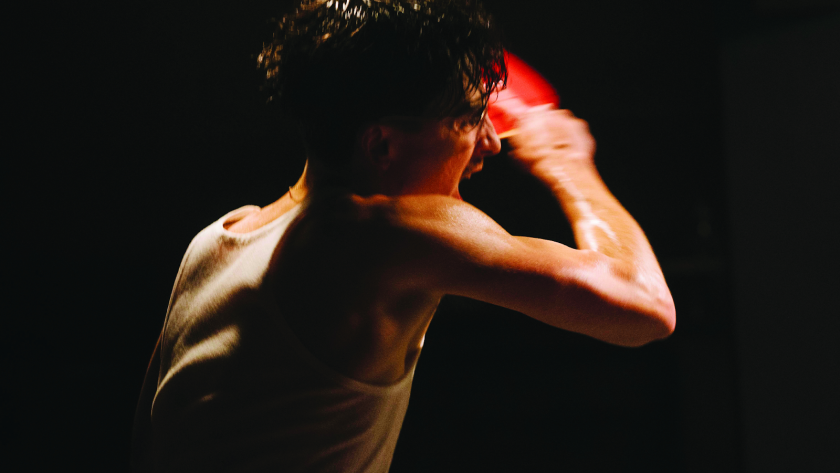
 Horace Hung
 Seemingly, the term “anxiety-inducing cinema” has mostly been referred to the Safdies’ filmography. The duo (Josh Safdie, Benny Safdie) achieved critical success for their indie breakout Good Time (2017) starring Robert Pattinson and Uncut Gems (2019) with Adam Sandler. Just as the Safdies are garnering recognition in the film circle, it was announced in 2024 that the brothers would part ways and pursue solo directing careers. Coincidentally, they both released sports drama films in 2025: Benny Safdie debuted the boxing biopic The Smashing Machine starring Dwayne Johnson, while Josh Safdie released the ping-pong drama Marty Supreme, which stirred Oscar buzz for Timothée Chalamet.
While I have yet to see The Smashing Machine, I remember it generated some award buzz when Benny won the Silver Lion at the Venice Film Festival. Unfortunately, the film turned out to be a box office bomb, grossing a mere $21 million against a $50 million budget. Then a month later at the New York Film Festival, people were suddenly raving for the fresh cut of Marty Supreme. The reactions were massively positive, to add to the impressiveness Josh said he just finished editing hours before this first screening. Fast forward to the time of writing, the majority has positively reviewed it on IMDb and Letterboxd. Receiving an overwhelming 9 Oscar nominations, we are very likely to see Chalamet winning his first Oscar. Everything seems unstoppable, akin to the adrenaline-rushing Marty Supreme.
Just as everyone is praising Timothée Chalamet’s leading performance as the Machiavellian Marty Mauser, we should not overlook Marty Supreme’s technical achievements. From film composer Daniel Lopatin, casting director Jennifer Venditti, cinematographer Darius Khondji, to production designer Jack Fisk, they all excel in their respective expertise. Combined with Josh Safdie’s unique vision, these made Marty Supreme an immersive experience overall.
Film Score
Daniel Lopatin (Good Time, Uncut Gems), an electronic music producer, returns to compose for Josh Safdie’s adrenaline-inducing Marty Supreme. His scoring style is often ethereal and progressive, featuring complex MIDI patterns and comprising a myriad of instruments. He imbues streams of life forces by utilising exciting flutes in The Call (opening sequence) or The Apple (when Marty first acquainted retired actress Kay Stone, played by Gwyneth Paltrow). In the optimistic Marty’s Dream, Lopatin sampled human voices in “bum bum” to act as chanting angels behind Marty; in the wild tale of Holocaust Honey Lopatin again experimented with choir sounds and church organ to represent Jewish pride (refer to Haran Iyer’s essay). The result is a complicated soundscape that departs from the conventional, orchestral score while thrilling to hear.
It is not hard to notice Lopatin’s score as the main driving force behind Safdie’s anxiety-inducing cinema. How did he achieve it in Marty Supreme? During one of the early ping pong matches against Endo (Koto Kawaguchi), Lopatin underlays the scene with slapping bass and exhilarating synth waves, partially mimicking the rising shepherd tone (Endo’s Game). This upbeat piece, my personal favourite, is one of the rare examples of Lopatin’s recurring leitmotif, as it reappears in the final Endo’s Game (Reprise) when Marty faces off his arch nemesis again. Lopatin’s score never features a recognisable, recurring leitmotif. Every score piece exists on its own and remains as a distinct artwork.
Like Josh Safdie’s direction, Daniel Lopatin adopted a maximalist approach, including as many elements in the score as possible. Interestingly the chosen soundtracks are mostly 80s songs (the film ends with Everybody Wants To Rule The World used in the trailers). Josh Safdie mentioned his philosophy of hauntology during one of the post-screening talks, where he aims to evoke cultural memory and musical aesthetics from the past, whereby Lopatin, the father of vaporwave, embraces this notion fully. The score, resembling Vangelis’s Blade Runner (1982) new-age ambience, also embraces the 80s. It is as if Marty is misplaced in the wrong era, chasing his dreams in the 50s. Lopatin described his score as “neoclassical” on the A24 channel, meaning Marty has to traverse all the way from his “old world” to the “new age” – Motherstone opens similarly to Akira’s main theme’s percussion, then follows with funky jazz; Holocaust Honey features Baroque rhythms and melodies. All these maximalist techniques serve a single purpose – to echo Marty’s motto, “Dream Big”. Marty envisages a dream no one has ever dreamt of; the music captures this spirit by, in Lopatin’s words, “a music that is yet to exist”.
Casting
Jennifer Venditti (Good Time, Uncut Gems) had an impressive year in 2025. Being the casting director for not only Marty Supreme but also The Smashing Machine and Yorgos Lanthimos’s Bugonia, her casting talents are recognised alongside Oscar’s new introduction of the Achievement in Casting category.
Like fellow American indie filmmakers Richard Linklater or Sean Baker leaning on cinematic realism, director Josh Safdie has always embraced neorealist filmmaking which can be reflected in his casting choices. Citing his favourite film as Vittoria De Sica’s Bicycle Thieves (1948), one can observe the resemblance between Josh’s filmmaking approach and Italian neorealism, that is to encourage the use of non-professional actors. Venditti not only cast professional and high-profile actors like Timothée Chalamet and Gwyneth Paltrow, but also included non-actors like Shark Tank personality Kevin O’Leary as business mogul Simon Rockwell, and controversial filmmaker Abel Ferrara as gangster Ezra Mishkin. Surely there is more: Tyler Okonma (Tyler, the Creator) made his acting debut as Marty’s partner in crime; “Penn & Teller” magician Penn Jillette as the ferocious New Jersey farmer; or professional table tennis player Koto Kawaguchi as Marty’s ping pong archenemy, Koto Endo.
But it is not as simple as merely including both professionals and non-professionals. Venditti said, in the Marie Claire interview, that they had to cast people who embody the film’s energy. “We will pick a scene and let people improvise. The scene is so intense that there is so much yelling and screaming – that matches the energy of Safdie’s film.” And this has been a tradition of the Safdies’ filmmaking. In Good Time frequent convict Buddy Duress was cast as Ray, a drug dealer that Connie (Robert Pattinson) reluctantly cooperated with; in Uncut Gems, not only former basketball player Kevin Garnett was cast as the Boston Celtics star, but also R&B singer the Weeknd. What differs from Italian neorealism is that the Safdies’ approach includes well-known celebrities, bringing audiences some familiarity in these cinematic worlds. That is exactly why the Safdies’ films are always so intoxicating to watch, there is so much chaos going on and you never know where the film heads. “The non-actors carry an unpredictability with them. They create this magic and mystery because life is unpredictable,” explained Venditti.
Cinematography
Cinematographer Darius Khondji (Seven, Amour) returns from Uncut Gems to shoot Marty Supreme. The previous two Safdie films (Good Time, Uncut Gems) still carry an “A24 lighting” – stylised RGB lighting and contrasting hues to give a neon-inspired look. Khondji ditched it completely in the period drama Marty Supreme, as he wanted to pursue the film’s “realness”. During one of the key scenes of Marty versus Koto Endo, minimal overhead lighting was used to focus on the match rather than the audience, resulting in the chiaroscuro on the character’s face, and giving the film a noir-ish look. Khondji also selected specific lenses, mostly long anamorphics, in his words during the American Cinematographer interview, “almost like having binoculars or a magnifier when looking at the characters.” Khondji’s motto in cinematography has always been “We all submit to the story”, then the choice of imperfect lighting makes perfect sense, that is to submit to the film’s pursued realism.
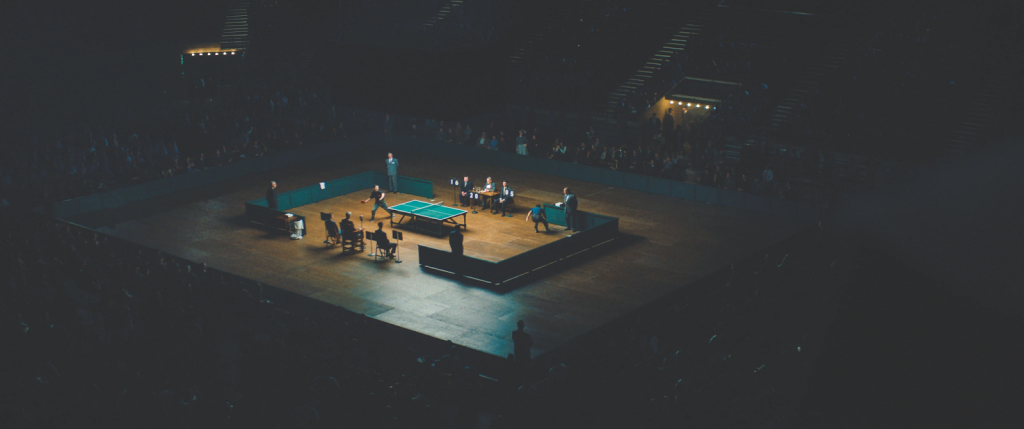
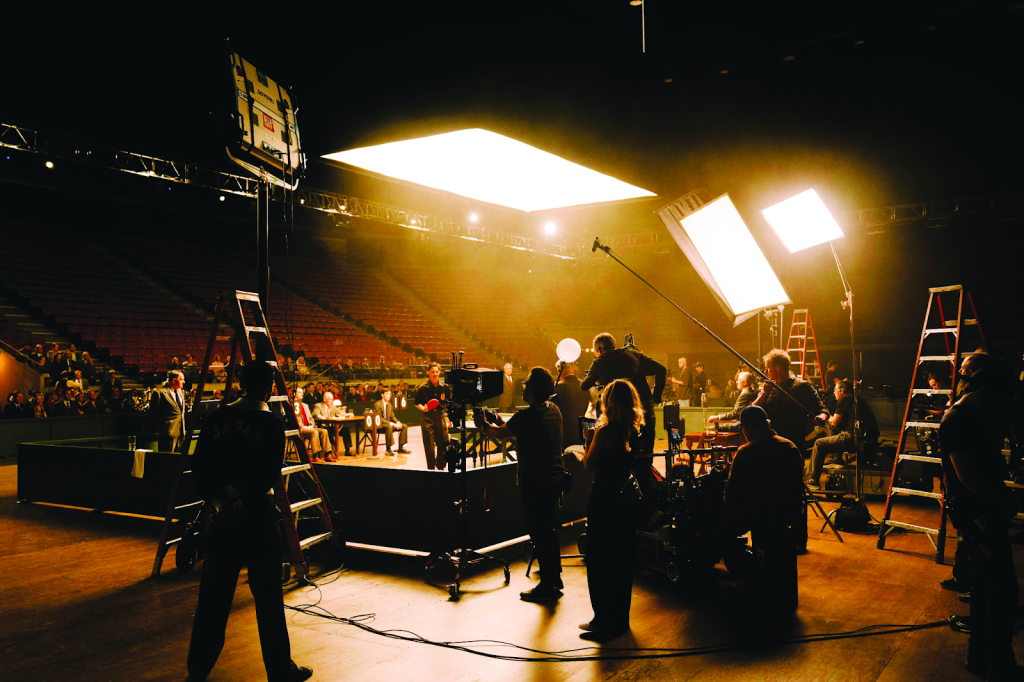
Overhead lighting used during the intense match between Marty and Koto
Like the Safdies’ Good Time and Uncut Gems, many suffocating close-ups and fast-talking characters in Marty Supreme add to the induced anxiety. Khondji had to choose tight lenses, and he originated on film since “he loves the texture of film on faces.” Béla Tarr, the late Hungarian auteur, saw “human faces as a kind of landscape.” The unconventional casting choices in Marty Supreme give the film a refreshing look, as we see the faces of non-actors in “obsessively tight” close-ups (as Khondji intended) which shape the ‘50s New York facial landscape that Josh Safdie envisaged.
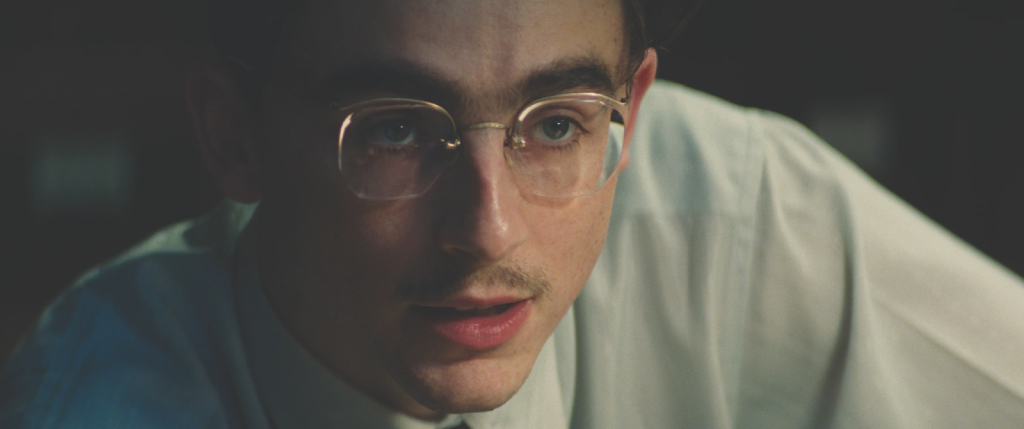
Tight close-up shots as one of Safdie’s filmmaking signature
Cinematography encompasses so many aspects: lighting, framing, composition, character blocking, camera movement, colour palette and more, essentially the mise-en-scène. Darius Khondji, being called the “prince of darkness”, is known for his mastery of low-key lighting. In David Fincher’s Seven (1995), Khondji’s cinematography captured the dark and gritty images of the neo-noir serial killer thriller. I do believe Marty Supreme exhibits many of the neo-noir characteristics – conflicted anti-hero in crime drama, thematic motifs of revenge, or making choices out of desperation. Khondji translates his craft of low-key lighting into Marty Supreme. In one of my favourite shots in Marty Supreme, we see Kay and Marty kissing intensely at the Central Park tunnel, blocking the single light source and creating shadows on their silhouettes. Khondji shot the scene with the striking use of light and shadow, reminding me of his stunning cinematography in Seven.
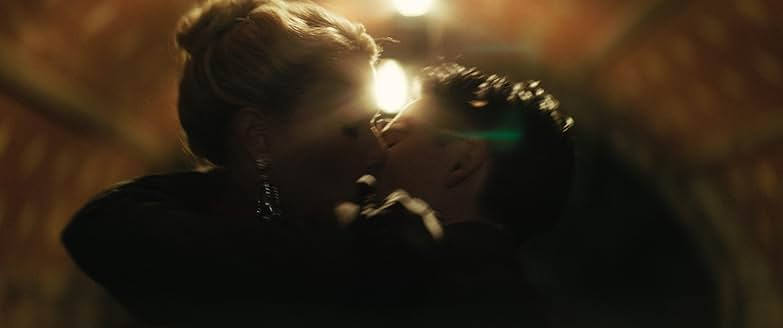
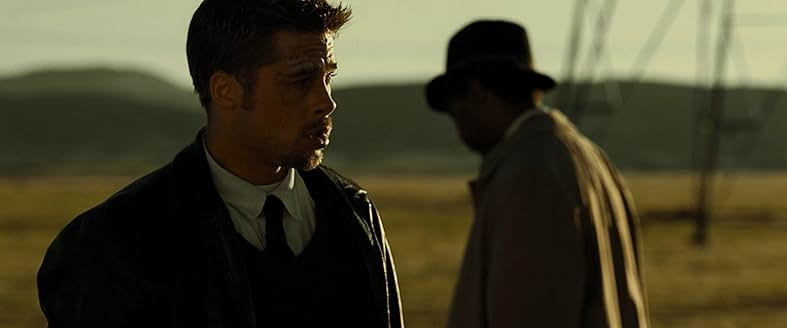
Low-key lighting in Marty Supreme and Seven
Production Design
Production designer Jack Fisk, a frequent collaborator with Terrence Malick, joins the crew of Marty Supreme to design the sets. Fisk’s resume is simply astounding, having worked with great directors like David Lynch, Paul Thomas Anderson and most recently Martin Scorsese, he is no stranger to period film set designs. Having worked with auteurs, Fisk said, working on Marty Supreme was still exciting for him, because “there’s a whole new wave of young filmmakers that are brilliant.” Fisk has just been nominated for his fourth Oscar, after There Will Be Blood (2007), The Revenant (2015) and Killers of the Flower Moon (2023). It leaves me wondering, after all his gorgeous set designs in primarily period dramas and westerns, how did he recreate the ‘50s New York outlook while Darius Khondji’s camera, as aforementioned, mostly zooms in on actors’ faces?
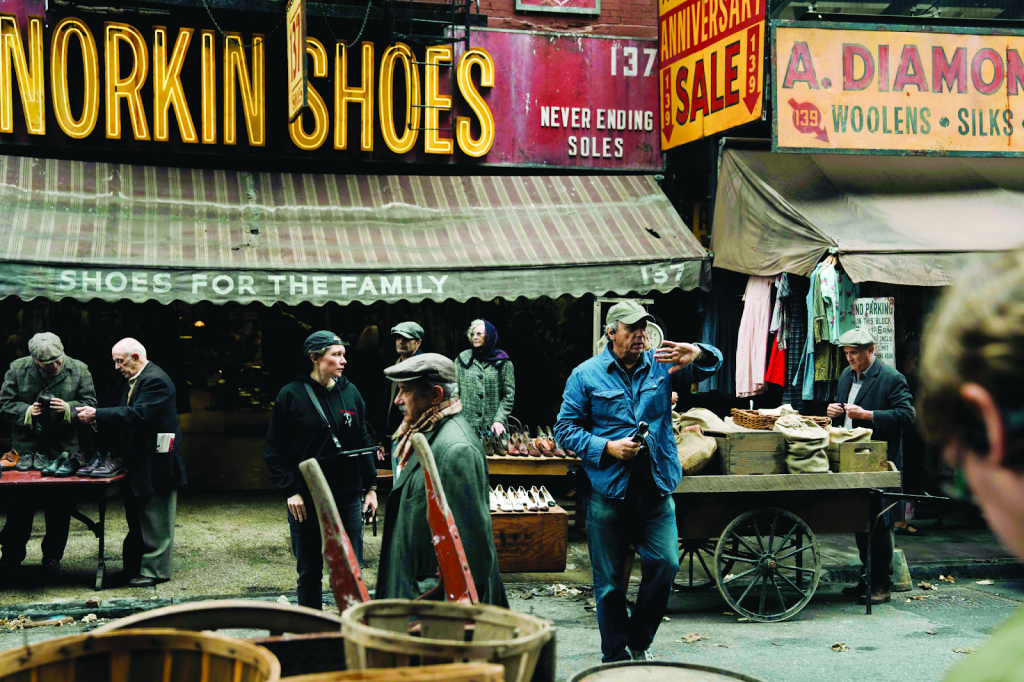
Recreating the 1950s Orchard Street
“We actually shot Orchard Street on Orchard Street,” Fisk says, which is the street where Marty Mauser’s shoe store is located. The problem is that the buildings were already modernized and there was graffiti which did not exist in the ‘50s. Fisk explains that set designers built a modular system of tenement fronts that covered the ground-level building fronts. Fisk recreated the facade of the ‘50s New York he used to reside. As previously mentioned, Fisk embraced the imperfection and “submit(ted) to the story”, as he would peel away paint and redesign the shoe store, whose ceiling was falling down, on location. There is something about shooting on location, or with Fisk’s almost seamless production design, that adds to the film’s authentic texture.
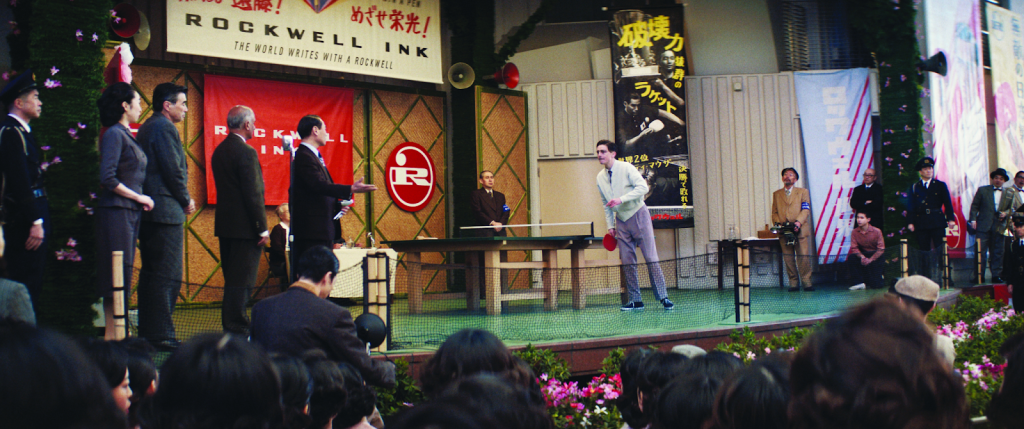
Final match taken place in Tokyo
In the climatic scene, where Marty and Endo had the last showdown, the crew had to prepare and shoot this sequence in around two weeks. After location scouting, Fisk and his crew found a concert shell in a park outside Tokyo. “It was perfect. It was close to the period and it looked like you were in another country. Our crew put together some towers out of bamboo that we then covered with Japanese graphics.” Fisk added that Josh Safdie was always ahead of him, being a perfectionist in every detail: the ping pong balls were slightly smaller back in the ‘50s, and for this final scene the ping pong table was based on an old Japanese one. Though Jack Fisk’s production design acts merely as the backdrop, his superb craftsmanship pulls you right back in time.
After all the technical discourse, Marty Supreme is, in fact, A24’s biggest gamble in recent years, alongside Civil War (2024). Costing nearly 70 million to produce, it has to do extremely well to coax moviegoers to buy tickets for a ping pong biopic. The result is the film’s out-of-the-box campaign – orange blimp over Los Angeles, eponymous jacket pop-up stores featuring sports personalities, Chalamet dropping 4 Raws with British rapper EsDeeKid, etc. At the time of writing the film has made nearly 150 million, becoming A24’s highest-grossing film (surpassing EEAAO (2022)). Seeing Chalamet so actively participating in the film’s campaign makes people care about his craft. He “dreams big”, he is on a relentless track to earn his first Oscar. Now he is doing retrospective talks with Denis Villeneuve and Christopher Nolan. He was once a young kid in Interstellar (2014) and Call Me by Your Name (2017). Now he is Lisan al-Gaib; he is Willy Wonka; he is Bob Dylan; he is, in fact, the real-life unstoppable Marty Mauser.