
 Haran Iyer
 *Please note that this article contains spoilers for Marty Supreme
When I think about Marty Supreme, my mind keeps going back to a quote by writer-director Josh Safdie, where he describes the film as a moment of “seeing your parents before you were born”. In my opinion, this perfectly encapsulates the film, illustrating it as one about a man’s dreams and ambitions before the responsibilities of adulthood define him. From the opening credits alone, Marty Supreme immediately establishes these core themes, contrasting individualism and a single-minded pursuit with a looming and inevitable pressure. What follows is the usual Safdie-induced ride of thrills, tension, and anxiety, spearheaded by a truly mesmerising performance from Timothée Chalamet. However, what truly makes Marty Supreme stand out for me is its relevance. During an incredibly memorable marketing campaign, Chalamet said the film addresses the bleak reality young people currently face, and it fully succeeds in doing so. Ultimately, Marty Supreme is a cultural product of our time, delivering incredibly resonant messages through an unforgettable experience.
Despite being set during the 1950s, Marty Supreme excels at creating a timeless experience, both through the production and the specific themes it tackles. Thematically, this is primarily conveyed through the portrayal of the titular character, Marty Mauser, and how he breaks traditional genre norms. Typical underdog films, such as Rocky (1976), explore ambition through an idealised portrayal of the American dream, emphasising how perseverance and hard work can help one achieve their goals. Marty Supreme takes a different approach. Marty’s ambition is characterised by his confidence, anxiety, and desperation to prove himself, and the film explores how he gets lost in an endless cycle of hustling and petty crime to achieve his dreams. He cashes in on any and every favour, manipulates those closest to him, and projects such sheer self-confidence to the point where he refers to himself as “Hitler’s worst nightmare”. He’s even willing to endure extreme humiliation if it means he can get an opportunity. His turmoil is never about if he can win when the time comes; it’s more about if he’ll even get that opportunity in the first place. This is where Marty Supreme resonates with its modern audiences, specifically younger ones. Due to a wide range of circumstances, many people find that no matter how hard they work or persevere, they cannot achieve their goals, perhaps not even getting a chance to prove themselves in the first place. This is what drives forward that timeless feeling, as, despite how immoral his choices are, Marty’s story remains resonant, allowing for Marty Supreme to transcend its 1950s setting. Reinforcing this is the film’s use of licensed music, with the frequent ‘80s tracks building on the idea that Marty and his struggles are ahead of his time.
Additionally, Marty Supreme also critiques the American dream through its historical context. Co-writer Ronald Bronstein described the film as one about “the America that emerges as victors after World War II,” and this is clearly evident in Marty’s character. In many ways, his individualism embodies the surge in American pride and belief in the American Dream following the war. The film highlights the dark side of the American dream, with Safdie’s maximalist, chaotic, and anxiety-inducing direction setting the stage for how Marty becomes an inevitable victim of his own pride. While his Americanness allows him to ‘dream big’, the brashness and overconfidence he derives from it contribute to his downfall and constantly put him at odds with others. In particular, his personality is often mirrored in his interactions with the older, more powerful generation, which are often presented as a clash of egos. This reduces the American Dream to a self-perpetuating cycle of pride and vanity rather than one of meritocracy. His desperation for this dream causes him to create problem after problem for himself, while also alienating himself from those he’s supposedly closest to. Bronstein reflects on this while discussing the cost of Marty’s ambition, stating, “it’s holding everything else hostage.” Marty’s struggles also represent the façade of the American dream in the 1950s. The period wasn’t as prosperous as what the United States was marketing it to be, with discrimination and hardship still prevailing for many. This falsehood is perfectly highlighted by the film’s use of the song Everybody Wants to Rule the World by Tears for Fears. Despite its upbeat tune, the lyrics convey the powerlessness of people at the time, despite their inherent desire and dreams.
The historical context is also crucial for understanding Marty’s character, as the war’s impact directly influenced his actions and behaviour. Marty constantly showcases his Jewish pride, and the film expertly captures a broader sense of identity-building following mass trauma. In one of the handful of scenes where we see him show genuine compassion, he gifts his mother (Fran Drescher) a chunk of stone he took from the Pyramids of Giza, proudly claiming, “We built this.” He calls himself the “ultimate product of Hitler’s defeat” and, in the same scene, makes a shocking Holocaust joke before going on to defend it by claiming he’s Jewish. Most notably, his Jewish pride is seen in his friendship with fellow table-tennis player and Holocaust survivor, Bela Kletzki (Géza Röhrig). When confronted by tycoon businessman Milton Rockwell (Kevin O’Leary), Marty eggs Bela on to tell a haunting story about his time in a concentration camp, a tale that is shockingly true according to the memoirs of Marty Reisman. By having Bela tell this story and forcing a privileged, non-Jewish character in Rockwell to confront the harrowing reality of the Holocaust, Marty undermines Rockwell’s own self-importance, highlighting Bela’s bravery, resilience, and compassion. He’s bolstering his own self-image, implying, with a bit of stolen valour, that he measures up to Bela by way of his own Jewish pride. The irony, of course, is that Bela’s story of compassion and selflessness sharply contrasts Marty’s incredibly selfish and individualistic pursuit of greatness. While Bela’s Holocaust story ends with him feeding his fellow prisoners, Marty constantly endangers and hurts his supposed loved ones in his pursuit of greatness. While Bela is content performing with the Harlem Globetrotters, Marty is initially dismissive of this, convinced that he has a greater calling that he has to pursue. Marty would have been a teenager during the war, therefore never experiencing the horrors that Bela went through, and probably not sharing his desire to move on. Through Marty’s character, the film captures the search for a new identity following mass trauma, and how it differs from a generation that experienced this trauma firsthand. His desire to build a name for himself, fuelled by both his American and Jewish identities, likely stems from an awareness of the horror that his cultural community faced when the Nazi party was in power. His pride in Bela’s story, alongside taking a stone from the pyramids, asserts his belief in Jewish resilience and presence across history. This is what makes him and his journey so compelling and interesting; he pursues greatness not just for himself, but so that the world can remember him.
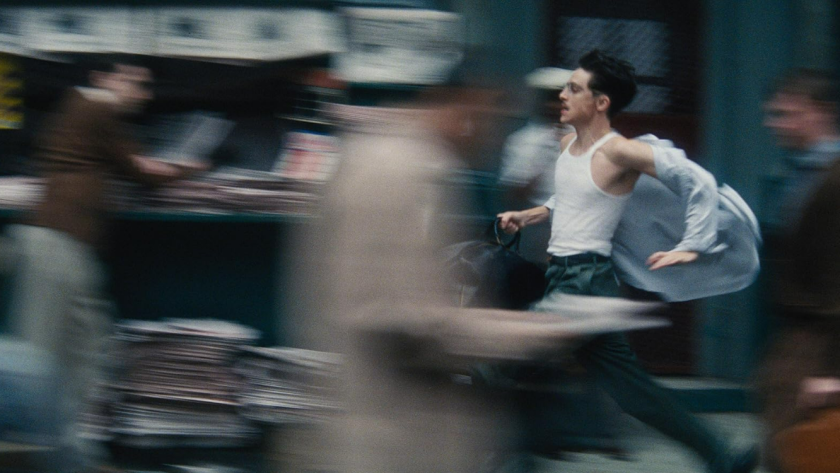
I’ve seen Marty Supreme receive criticism for failing to condemn his actions or, at the very least, have him learn a lesson. I strongly disagree with this sentiment, as the film explores how Marty treating his close ones like collateral damage puts significant strain on their relationships and well-being, thus showing how his actions aren’t justifiable. This is much more satisfying because it underscores the theme of the cost of extreme ambition. Most crucially, the fact that he doesn’t achieve his dreams by the end of the film is stronger than any outright condemnation. It is such a satisfying ending, forcing a relentless narcissist to finally be pulled back down to Earth, painting an ironic contrast to the title: Marty Supreme. Yet despite this, the film’s ending is surprisingly hopeful. His dream is finally over, but he ensures that it dies on his terms. Despite it coming in a pointless fixture, Marty’s victory against Endo (Koto Kawaguchi) finally gives him the peace that he was the better player, and he can finally move on to what really matters. By accepting that he’s the father of Rachel’s child, Marty finally stops running from the responsibility that was chasing him throughout the film. It’s the final nail in the coffin for his dream, with the final needle drop indicating that he’s found a new life. One where he’s found something more important than himself. He might have had to surrender his ambition for this unglamorous reality, but the film ends with his dream being somewhat achieved. Throughout the runtime, Marty fights desperately to build a name for himself. To build a legacy. To ensure that his name lives on. And when he looks into the eyes of his newborn child, he finally knows that it will.