 Horace Hung
 Director Ryan Coogler’s recent critically and commercially acclaimed vampire horror film, Sinners (2025), is a triumph for non-IP blockbusters (grossing nearly 370 million internationally), considering we’re flooded with the proliferation of sequels, and remakes and spin-offs. His long-time collaborator, Ludwig Göransson (two-time Oscar winner in Best Original Score), is projected to be the frontrunner in the same category in 2026. Two songs from Sinners, both co-written by Göransson, were submitted to the Best Original Song category – Miles Caton’s temporal-transcending I Lied to You, and the climactic farewell duet between Alice Smith and Caton’s Last Time (I Seen the Sun).
Ludwig Göransson was born and raised in Sweden. Heavily influenced by his guitarist father and anticipated to achieve high calibre in music like Ludwig van Beethoven, he also learned to play guitar from childhood and continued to study film scoring at the University of Southern California, where he befriended Ryan Coogler. After graduation, he worked on Donald Glover’s sitcom Community, later the duo released Grammy-nominated albums under the alias Childish Gambino. Meanwhile, Göransson has worked on every Coogler project – but Sinners is their first non-franchise project ever since the debut of Fruitvale Station (2013). In 2018 he won his first Oscar for Black Panther. In the very same year he and Gambino released the viral record This is America and won all four of the nominated Grammy categories. He was only 33. He later collaborated with Nolan on Tenet (2020) and Oppenheimer (2023) in the “post-Zimmer era” (since Hans Zimmer scored for Denis Villeneuve‘s Dune (2021) instead). He won his second Oscar for the latter, a biopic on the father of the atomic bomb. Nolan’s upcoming Greek epic The Odyssey (2026) will mark their third collaboration.
Sinners (2025) marks the fifth Coogler-Göransson collaboration. The film stems from Göransson’s first encounter with music – guitar. Vastly derailed from the authentic African music, the talking drums and chanting tribes in Black Panther; the upbeat and bombastic electronics that inversely traverse time in Tenet; or the haunting orchestral strings, experimental synthesisers in Oppenheimer, Sinners’ backbone lies within blues music during the 30s in the Mississippi Delta and refurbished Irish traditional folk songs. Sinners is no mere musical – albeit it features 22 soundtracks (songs) and 19 score tracks (instrumental), composed by a myriad of artists like blues musician Bobby Rush and Buddy Guy (playing old Sammie in the post-credits), rappers Don Toliver and Rod Wave, etc. In the film, our protagonist, Sammie, plays music that conjures spirits from both the past and the future, thus captivating the vampires. Music not only serves as a conventional, emotional cue, but also as the 4th-dimensional soundscape that shapes Sinners’ cultural background, and the clashes of musical genres.
“Travelin'” – Musician’s Dream
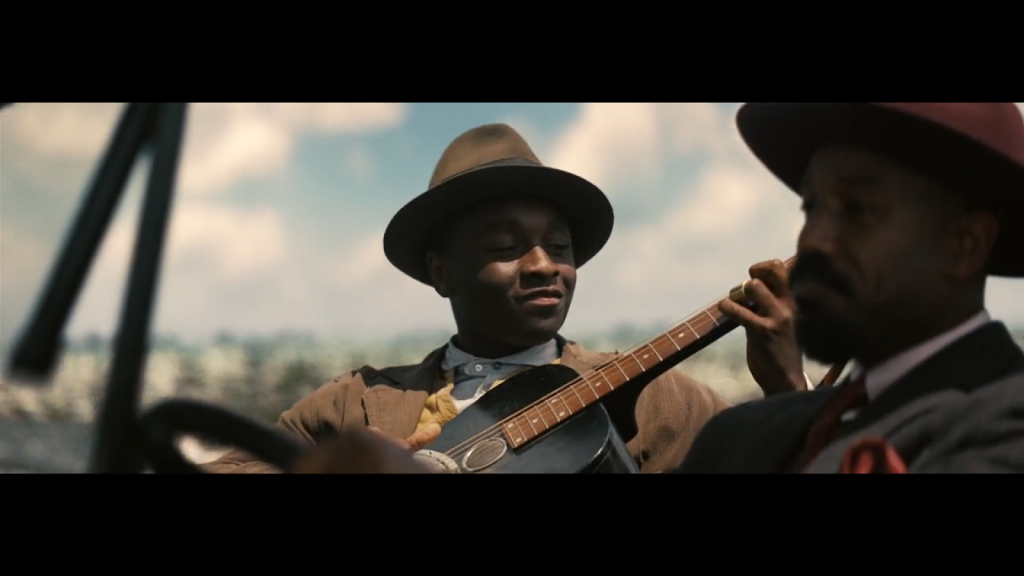
Sammie (Miles Caton) serenades Stack (Michael B. Jordan) in pursuit of pianist Delta Slim (Delroy Lindo), while playing the 1932 Dobro guitar and singing “Travelin’, I don’t know why in the world I’m here.” He puts a slider on his ring finger (back in the days beer bottlenecks were used as the slider) and according to Göransson, “he slides on the guitar as if it is singing” – akin to the Black Panther talking drums. Sammie’s pastor father worries about the sins of blues music, thus warns Sammie’s dream of becoming a blues artist. Troubled and lost, he continues singing “Saddlin’, I don’t know which way to go.” Blues music has always been about black people’s struggles.
“Why You Here / Before the Sun Went Down” – Erotic Love
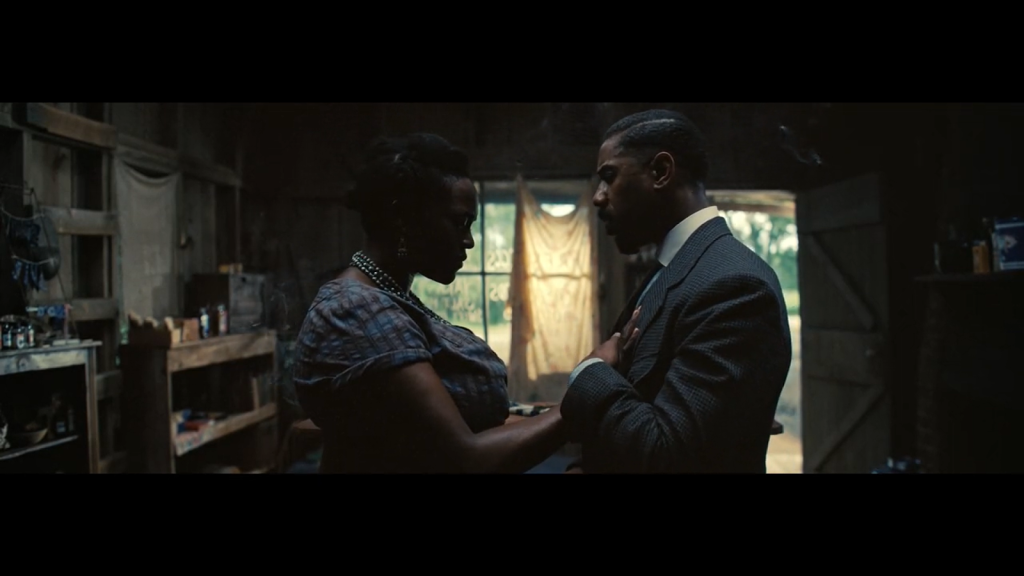
Smoke (Michael B. Jordan) revisits his wife Annie (Wunmi Mosaku) in a remote house. The love motif is played by a 5-note acoustic fingerstyle guitar, evoking an ethereal and dreamy atmosphere. Film composer Hans Zimmer once claimed, “In music, you’re basically having a conversation.” The guitars call and respond, as if we hear Annie questioning Smoke, “why you here?” Their love motif is initially tranquil and calming, and in fact, serves as the melodic rudiments of James Blake’s song “Séance” in the soundtrack album. The title, meaning the ritual of contacting the dead, appears to imply the ultimate, inevitable bloodbath. In the chorus, as Blake sings in falsetto, the love words go “Still I’ll adore you, I’ll adore you.” Later the score grows in crescendo whilst the couple caresses intimately, bouncing with 808 bass (Göransson’s signature), morphing into exhilarating electric guitars, and eventually erupts into Miles Caton’s baritone uproar, as the film cuts to Grace and Bo preparing for the juke joint’s opening night. This score happens “before the sun went down”, since something devilish awaits them at night.
Other than “Séance”, Göransson also composed characteristic love themes for every pair – the ethereal “Dangerous” by Hailee Steinfeld for Stack and Mary, and the horny “Pale, Pale Moon” by Jayme Lawson for Sammie and Pearline. All are quite infectious, I shall say.
“I Lied to You” – Transcending Time and Space
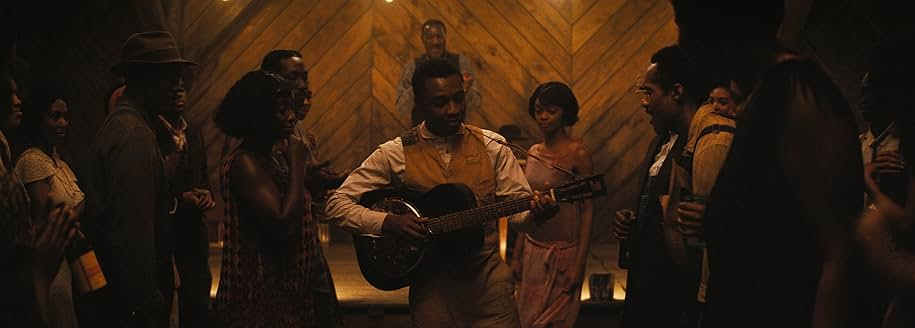
Sammie plays swing blues on his guitar, accompanied by Delta Slim’s jazz piano. He sings:
“Something I been wanting to tell you for a long time
It might hurt you, hope you don’t lose your mind
Well, I was just a boy, ’bout eight years old
You threw me a Bible on that Mississippi road
See, I love ya, Papa, you did all you could do
They say the truth hurts, so I lied to you
Yes, I lied to you
I love the blues”
Blues was created during the times of black hardship as a means to express struggle and discrimination, to seek personal freedom amid slavery. This thus parallels Sammie’s struggle in pursuing his musician’s dream, despite his father’s rejection. Sammie “lied to him”, he really “loved the blues.”
Miles Caton’s baritone voice is mesmerising, as if an old soul trapped inside a young singer. After the chorus something unprecedented occurs – Göransson turns the seemingly conventional blues guitar music into a trap house beat, African tribal members playing Kora (African harp) for the beat riser, background gospel chorus harmonising, a 60s rocker emerges and riffs an electric guitar, and the beat drops as the DJ scratches the disk while he plays 80s old-school hip-hop. Ad-libs, attacking bells and slapping hi-hats and snares followed by ragtime piano and African djembe drum. “I hope you can stand, stand it all,” meanwhile the kicks slip in, hip-hop vocals chant, and breakdancers twerk. Then the high-pitched stylophone is followed by a Chinese gong, cueing the Peking opera dancers. The music is cacophonous and should not work – but Göransson’s brilliant and experimental score shifts genres and cannot be conventionally categorised – any dissonance heard is challenged. Göransson raises the beat again, after the climax Caton’s voice morphs into autotune, mimicking modern rappers, and he sings like riffing an electric guitar. His transcendental music conjures Black and Chinese spirits from the past and future, yet he fails to notice his music lures Irish vampires, who aim to seize his spiritual powers to resurrect the deceased members. Perhaps in the blood-red eyes of Remmick, Sammie’s “I Lied to You” announces his battle cry.
“Pick Poor Robin Clean” – Cultural Appropriation
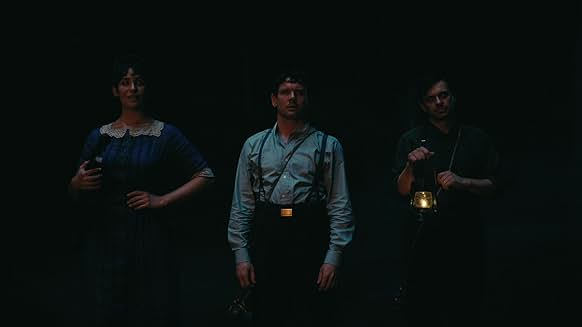
Attracted by Miles Caton’s surreal music, the trio arrive at the juke joint and sing “Pick Poor Robin Clean”. Wishing to join the party in vain, they taunt the group of mortals. On my first watch I assumed they were performing Irish folk songs. The trio are playing Banjo, an Irish instrument. In fact “Pick Poor Robin Clean” was an African-American folk song and one of the earliest recorded blues, later popularised by Geeshie Wiley and Elvie Thomas in 1931. Remmick (Jack O’Connell) and the other vampires appropriate this black song, a perfect simile of the historical appropriation and exploitation white musicians have done to black musical talents (e.g. Elvis Presley). The lyrics go:
“I picked poor Robin clean, picked poor Robin clean
I picked his head, I picked his feet
I woulda picked his body, but it wasn’t fit to eat”
Tonally comedic and light-hearted, Remmick tries to appear harmless to the juke joint members, yet the Banjo played sounds utterly unfitting for a blues song, and the grotesque lyrics cannot hide Remmick’s bloodthirst. Turns out Remmick’s vampirism is in the name of love and equality, he vampirises others to build his clan – “Can’t we just, for one night, just one night, just all be family?”
“Rocky Road to Dublin” – Vampire’s Kicks
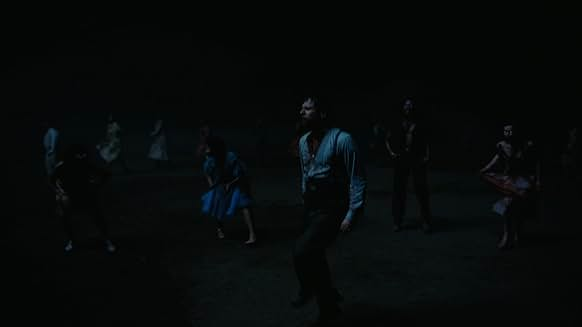
“Rocky Road to Dublin” is a 19th-century Irish song written by Irish poet D. K. Gavan about a man’s experiences as he travels to Liverpool, England, from his home in Tuam, Ireland. It parallels Remmick’s position, as he’s stuck in 30s Mississippi Delta and far away from his cultural roots. Remmick sings it as he gathers a crowd of vampires, tap dancing and chanting. In a scene reminiscent of a Ku Klux Klan cross burning, this song is the perfect response to Sammie’s “I Lied to You”. It’s Remmick’s battle cry to taunt the juke joint survivors while asserting cultural identity, his subtext of assimilating the black comrades and recruiting them as a cult.
Göransson again modernises this Irish song with 808 bass, common in modern hip-hop, by adding more bounce to the Irish tap dance kicks. Nearly in every film score he attempts to mesh the 808s with another music genre: in Black Panther, he underlays the talking drums of T’Challa’s leitmotif with 808s in Wakanda Origins to contrast the modern Wakanda with traditional African customs; in the cerebral, time-inversion Tenet, the 808s in Freeport and 747 during the infamous airport heist scene yield the futuristic soundscape; in the explosive, espionage-style Oppenheimer, he includes the 808s in Fusion – when Oppenheimer acquaints Fermi under the baseball court – to mimic the explosive sounds. This has since become his signature style – fusing genres, especially with 808s and synthesisers, to construct a tonally novel and innovative soundscape.
But what surprises me is the leitmotif for the Irish vampires – gothic, reminiscent of Bram Stoker’s Dracula yet stands out on its own. The eight-note electric guitar pattern can be heard at the end of Not What He Seems / Sé Abú, and throughout Hole Up ‘Til Sunrise, Together Forever and Bury That Guitar. And there’s a whole mix of organ chord progression, vibrato guitar followed by funky bass, and ultimately the riveting, blues-inspired progressive rock in Bury That Guitar. You do hear the virtuosity of countless instruments inside Göransson’s score, nonetheless the leitmotif for every single character remains clear and fresh. Film score maestro John Williams has once said, “If the score spiritually satisfies with the scene that it’s accompanying, then I think it’s successful.” There’s a vibrant prowess in Göransson’s score; he never relies on musical clichés, instead he subverts them.
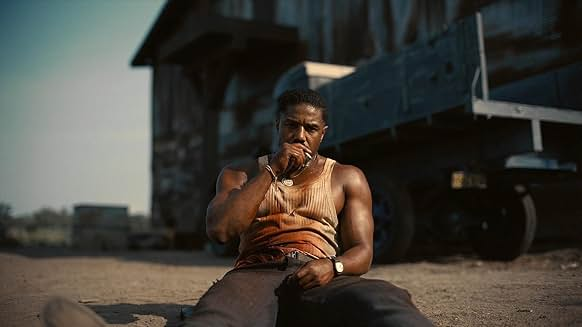
Apparently, a new wave of film composers has emerged in recent decades, those who ditch traditional film scoring practices and venture into the soundscape unheard of. Last year The Brutalist film composer Daniel Blumberg took home the Oscars and BAFTA with his cold, experimental yet epic score, blasting the four brass-horning notes whilst witnessing the inverted Statue of Liberty (Overture (Ship)). And you may have noticed the trend of band musicians turned film composers, alongside Blumberg is Radiohead guitarist Jonny Greenwood, a frequent collaborator of Paul Thomas Anderson. This new wave of film composers has evidently reinvigorated something new to the industry, deviating from the predictable, orchestral classical film scores or the forgettable temp music. Film score belongs to cinematic language, and there are film composers pushing boundaries of how films sound: Ludwig Göransson opens a rock concert and invites blues artists alongside Irish folk singers in Sinners; Jonny Greenwood experiments and plays with the piano notes (Ocean Waves, Like Tom Fkn Cruise), and the Hitchcockian car chase sequence (River of Hills) in PTA’s political thriller One Battle After Another; or Daniel Lopatin’s complex MIDI synthesizers, especially the slapping basslines (Endo’s Game) in Josh Safdie’s anxiety-inducing Marty Supreme. Recently I caught Christopher Nolan’s The Odyssey six-minute prologue at BFI IMAX. I can promise you, Göransson’s score exceeds itself again, although just a snippet. Aren’t we living in the best times of film scores now? Next time when you watch a film, try to listen to the score – an exceptional score should be a quantum superposition of familiarising you with the atmosphere whilst confronting your sentiments. Go to the nearest cinema, pay attention to the music like enjoying an album, otherwise all these audible details are dismissed on your laptop or streaming service.