
 Mckayla Tan
 When we watch a film, we are introduced to a new world, slowly getting to know the characters, places, and past events that shape the narrative. But when we watch a film about art, the director introduces a whole new layer on top of the world we are only just beginning to know. Great films use this art as an extension of their fictional creators, presenting the viewer with masterful character studies.
In Sentimental Value, Joachim Trier weaves cinema with ‘reality’ as he deliberately confuses the viewer between acting and actor, blurring the line between performance and truth. Much of this is similar to the movie Gustav (Stellan Skarsgård) makes throughout the film, which he extends as an attempt to communicate with his estranged and angered daughters. When Rachel Kemp (Elle Fanning) asks him about her character, he is unable to answer—not only because of his inability to converse about his complicated feelings, but because the story he writes is a tapestry of varied experiences, including his mother’s tragic end, a meta-commentary on art, and a subliminal message to his daughters. Gustav’s youngest, Agnes (Inga Ibsdotter Lilleaas), appears to be a functioning mother and wife, but is still deeply affected by her disjointed childhood. Meanwhile, his eldest, Nora (Renate Reinsve), is a successful theatre actress, struggling with inner demons. In the midst of all this silent suffering, Gustav chooses to prioritise his ambition as a director over his role as a father, using alcohol to anesthetise his guilt. The fractured dynamics of this dysfunctional family, both between the sisters and in their parallel but asymmetrical tense paternal relationship, are ultimately the film’s affective focal point.
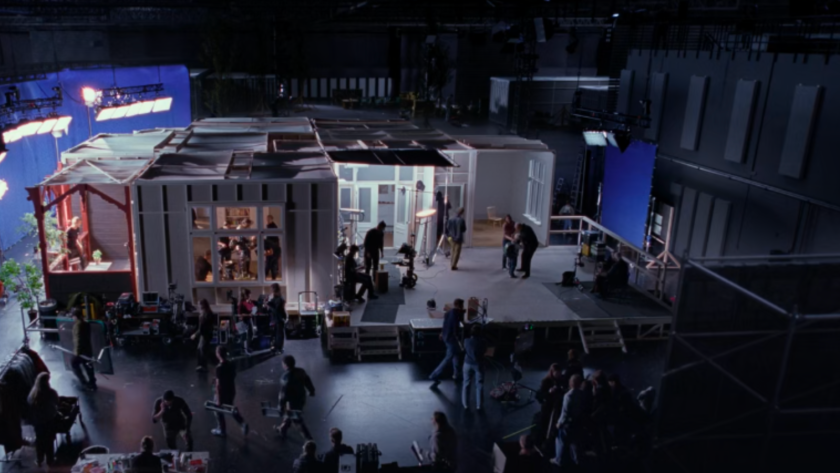
We begin and end with a house. This house becomes the thread that stitches the family’s history together, as we see it as a place for Agnes and Nora to mourn their mother’s death, only to be transformed into a film set marked by acting devoid of the script’s intended authenticity. Past and present blur into one ambiguous hallucination, just as in Gustav’s script. The walls of this house become a palimpsest of their shared past as the movie occasionally shifts from the main story to flashbacks, offering glimpses of their family life without laying it all bare at once.
Agnes and Nora have distinct relationships with their father, each reflecting how he views them versus how they wish he would. Gustav sees a clear mirror in Nora, both of them sharing an interest in the arts. The viewer often oscillates between sympathising with Gustav when his olive branch is rejected and being torn over the grave impact his absence has on Nora. It’s fitting that their most intimate moments are in silence—sharing a cigarette, a laugh together, and their final look, which seems to understand everything.
Although Gustav’s relationship with Agnes is comparatively less central to the movie, it is just as fragile. While the two of them talk, none of it is honest communication. The only moment of truth between them comes when Gustav insists that her young child, Erik (Øyvind Hesjedal Loven), become involved in his film, which finally makes her snap. Her desperation to maintain the unadulterated joy of his childhood is an attempt to break the family’s vicious cycle of tainting and traumatising young innocence. While she enjoys being in her father’s film, she also admits that his disappearance continues to confuse her as an adult, leaving her unsure whether he was directing her as a daughter or whether the director just happened to be her father. When Gustav says that his daughters are the best thing that happened to them, we are still left wondering whether that statement comes from the love in his heart or from the fact that his daughters were a useful commodity for his art.
But through all this confusion and blurriness, one thread remains clear: the bond between Nora and Agnes. We watch as Agnes continues to be deeply concerned with Nora, attuned and aware of her mental health struggles, and implicitly afraid of losing her. When Nora asks her how she has turned out relatively well despite their identical developmental scars, Agnes tells her that it was because of how Nora took care of her as a child, filling the void left by their absent father and depressed mother. Both sisters take on caretaker roles for one another without hesitation, highlighting the enduring nature of sisterly love as a means to break the family cycle of tragedy.
We begin and end with a house, but the house we end on is sterile and devoid of memory, completely lobotomised of the lives that once inhabited it. The movie ends with the one shot that Gustav has been building up to – a shot he describes as a ‘complete sync between time and space’. This final scene is uninterrupted, and we watch it as Gustav intends. At last, all the threads Trier lays out are resolved, in complete harmony.
In a film where most characters struggle with ‘tell’, the ‘show’ becomes even more integral to relationships – a burden that all the actors take on with careful thought through microexpressions imbued with incredible nuance and vulnerability. Much of this is significantly enhanced with Kasper Tuxen’s remarkable cinematography. Just like Rachel, the viewer is deliberately made to feel like an intruder in intimate moments between family members, as we are provided a (sometimes literal) window into their lives. Fortunately, however, important revelations about the characters’ pasts never feel too uncomfortably intrusive, thanks to how raw the characters feel. Weaker parts of the movie are the moments with too much ‘tell’, such as some beautifully written lines about art that feel slightly out of place in an otherwise subtle film. However, once the ending rolls, you forget about those minor imperfections, and leave with a sweetly aching hole in your chest that leaves you both satisfied and sentimental.
Written by McKayla
Edited by Arvind