 Edward Lahner
 Last month, I was methodically flicking through my emails, my online post, when I found a request to review British-Armenian director Richard Melkonian’s debut feature film Universe25 ahead of its London premiere at the Armenian Film Festival. Normally, I ignore these sporadic PR requests, ‘I’ve got something more important to be doing’, but on that Friday morning I decided to open the Vimeo link. Melkonian’s film starts from a similarly random discovery as Jacob, a post officer, stumbles across a lost envelope with a set of scrolls written by an angel called Mott. The opening line encapsulates this peculiar fate: “Who is my master and how have I come to be?” I asked myself the same question as this independent film took me down a deeply compelling rabbithole, resulting in conversations with the director, lead, and DOP at the premiere.
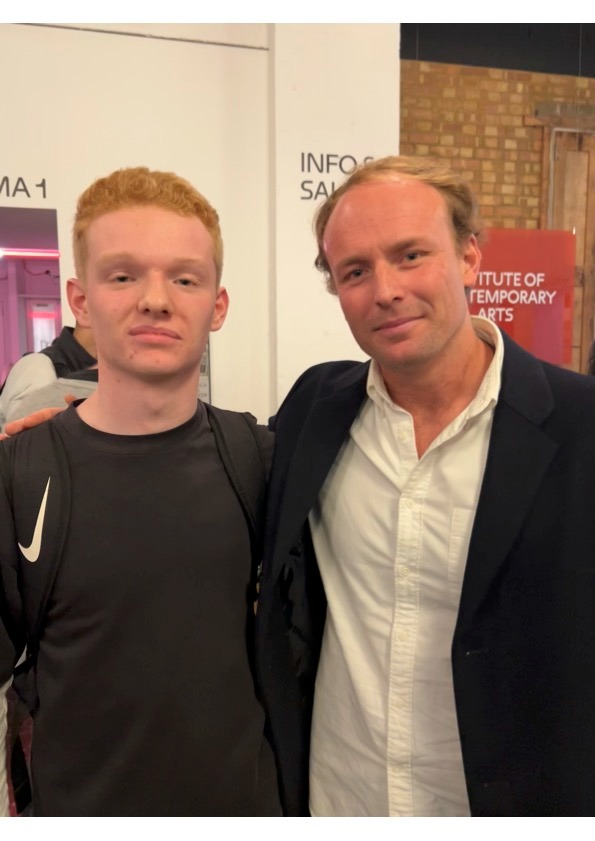
Universe25 is a project nearly five years in the making and was produced on a tight budget of £60,000. The creative process is fascinating: instead of writing a complete script and waiting for approval, Melkonian simply made the film, devising the storyline as he went along. It tells the story of Mott, a computative angel from the future who is sent on a holy mission to London and Bucharest to find a saint and, inadvertently, himself. As I make my way from Piccadilly Circus to the Institute of Contemporary Arts, I reflect on my own identity, wondering how best to introduce myself to the director. I spot Melkonian outside the venue. He’s wearing a dark blazer, white shirt, black tie, three-quarter-length trousers, and loafers, sharing a cigarette with some friends. As I approach, I listen in, hoping for an opportunity to intervene. “Apparently there’s a guy from UCL…” That’s my cue. Isn’t fate a funny thing?
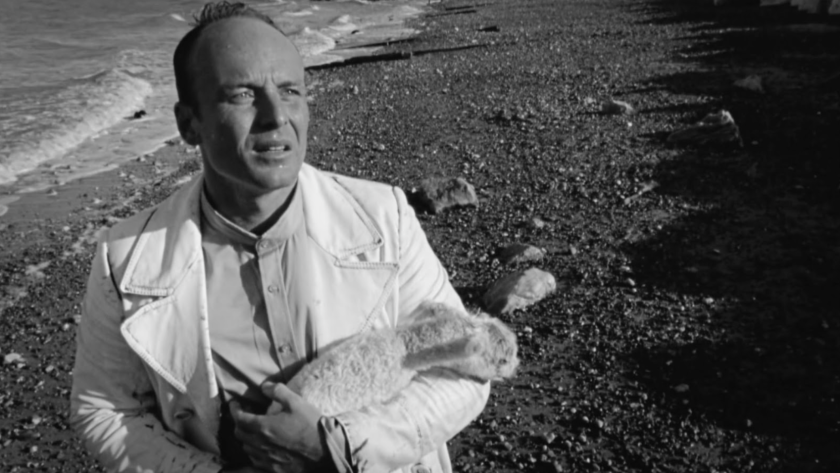
In the film, Melkonian immediately blurs religion with technology as a slimy Mott spawns on a bridge over the A4, mirroring the emergence of Arnold Schwarzenegger in The Terminator. Wim Wenders’ Wings of Desire is ostensibly the strongest reference point; however, Giacamo Gex’s angel isn’t as innocent or divine as Bruno Ganz’s: his face is sharper, his hair is recessed, and his mannerism is more callous. I mention this comparison to Gex who bursts into laughter: “I knew you were going to say that!” He tells me that Wings of Desire was not a conscious thought whilst playing the role, but accepts that people will perceive his character in many different ways: “That is art after all.”
The visual language of the film is also unique, with Melkonian and his DOP Juanjo L. Salazar opting for 16mm Celluloid Kodak film which cuts into the clarity of the images, accentuating the mysterious ambiance. In our conversation, Salazar is very humble about his work, but his talent is undeniable. Within the stuffy confines of a Wong Kar-Wai-esque neon green telephone box, Mott picks up the phone and listens to the distorted voice of his creator who instructs him to find a saint, a lamb to sacrifice, and to write a scroll in which he must record all his observations.
Mott, who also goes by Tom, observes the “primitive” human technologies around him, but it is the concept of love which transfixes him the most as he watches a couple make out in the street. This is when the film switches from what we can learn from an angel to what an angel can learn from us. The angelic dogma fails to account for human subjectivity as Mott is mocked as a schizophrenic hallucination by Andrei, the owner of a dance company, whom Mott suspects of being the saint. The absurdity of the angel is most prominent when Mott follows Andrei to Bucharest, preparing himself for the pilgrimage by squatting and walking with a crucifix on his back: “Carrying the weight of the world are we Tom?” Gex and Melkonian recount how the idea started as a joke in a wine bar one night. Less amusing is when the angel is later confronted by three teenagers who shove Mott over and urinate on him…
Having tracked Andrei down to a Bucharest houseparty, Mott succumbs to an internal crisis after discovering that “the saint is a devil.” Andrei has gambled his family’s inheritance away, his company is on the verge of collapse, and he regularly cheats on his girlfriend. We also discover that Andrei’s brother, Darius, is similarly transgressive. Consequently, Mott is forced to grapple with the facade of his angelic status, untangling the programming which forces him to obey. Melkonian, a filmmaker but also a musician, composes all the music in Universe25, including a brilliant musical number during the houseparty. I am also astonished to find out that the non-diegetic score was recorded in a singular day.
The next morning, Mott follows a ringing phone and is lambasted by his master: “You have strayed far from your path. You want to fall in love with them. You want to mingle with them. Most beings can choose some things in life, but not their nature.” Mott reawakens in a hospital after being stabbed by Darius and performing a The Seventh Seal style sacrifice to his master. He sees a literary agents’ advertisement in the paper, but writes an incorrect address on the envelope which duly finds itself in lost mail and the hands of Jacob. Mott may be an ordinary man after all.
Melkonian walks a fine line between making a film which some will laud as brilliant and others as pretentious, but he lets you decide. Although there is an obscurity to the religious symbolism and technological commentary, we are left with some palatable breadcrumbs; notably, the film’s title refers to John B. Calhoun’s 1968 experiment: an attempt to build a mouse utopia with unlimited resources which led to social breakdown in mouse behaviour. In an increasingly digitised age, where AI is expanding at a similarly cancerous rate to Calhoun’s mouse colony, Universe25 ultimately argues that it is the order of our humanity which is at stake. As I take the tube home from Piccadilly Circus and prepare to tell my flatmates about my bizarre Sunday evening, I think about all the previous stories that I’ve missed out on. For a brief moment that weekend, it was the humans who triumphed.